
Family Devotionals: The Tabernacle Was Built
Dear Parents,
Thirteen of the last sixteen chapters of the Book of Exodus contain instructions for building the tabernacle. The word tabernacle means “dwelling place.” The tabernacle was a portable tent where God met with His people. God wanted to dwell among them. (See Ex. 29:45-46.)
Moses had been on the mountain talking with God for 40 days. God wrote the Ten Commandments, the words of the covenant, on tablets. When Moses returned to the camp, he called all of the Israelites together and gave them the instructions God had given him. (Ex. 24:3-4)
God’s directions for building the tabernacle were very detailed. God was not trying to burden the people; He was trying to show them His holiness and absolute authority. God appointed Bezalel and Oholiab to oversee the building of the tabernacle, giving them wisdom, understanding, and craftsmanship. Every skilled person “whose heart moved him” eagerly worked on the tabernacle of the Lord. (See Ex. 35:30-35; 36:1-6.)
God gave the Israelites the tabernacle as a visual picture of His dwelling with them. The tabernacle—and later the temple that replaced it—was a temporary place for God’s glory to dwell until the coming of Christ. (2 Cor. 4:6) Every part of the tabernacle was designed to illustrate God’s relationship with His people.
Jesus is the New Testament fulfillment of the Old Testament tabernacle. John 1:14 says that “the Word became flesh and took up residence among us.” Jesus made His dwelling with people.
As you talk to your kids about the building of the tabernacle, show them God instructed the Israelites to build a tabernacle where He would dwell with them. God desires to be with His people. As part of His plan to save sinners, God sent Jesus to “tabernacle,” or dwell, with people on earth. Emphasize that in the future, He will dwell with us forever. (Rev. 21:3)
Family Devotional: The Golden Calf
Dear Parents,
God led His people into the wilderness, but He did not leave them there alone. The Lord was with His people. He provided meat, bread, and water. He guided them to Mount Sinai, where He met with their leader, Moses. The Lord came down on the mountain in fire, and He spoke through thunder. The Israelites could not have ignored His presence.
But when Moses went up on the mountain and did not return for several weeks, the Israelites felt abandoned. They appealed to Moses’ brother, Aaron: “Come, make gods for us who will go before us because this Moses, the man who brought us up from the land of Egypt—we don’t know what has happened to him!” (Ex. 32:1)
Aaron’s response led the people to commit a terrible sin. He gathered gold from the people and made an image of a calf, and the people worshiped the golden calf. God saw what the people were doing, and He told Moses to go down the mountain at once. Moses confronted his brother. Aaron claimed that when the people gave him the gold, he threw it into the fire, and “out came this calf!” (Ex. 32:24)
God punished His people for worshiping a golden calf, and Moses returned to the mountain to ask the Lord to forgive the Israelites’ sin. Moses could not atone for the people’s sin; God said He would hold the people accountable for their sins, but the Lord did not abandon the Israelites.
Introduce your children to the concept of idolatry. An idol is anything a person puts in the place of God. Explain that idolatry is a sin. The Israelites deserved to be punished for their sin. In the same way, we deserve to be punished for our sin. Point out that God’s people sinned against God, and Moses asked God to forgive them. Moses acted as their mediator, standing for them before God. Moses could not do anything to make up for their sin, but we have a better Mediator—Jesus. Jesus paid for our sin on the cross and stands for us before God. When we trust in Jesus, our sins are forgiven.
Family Devotional: The Ten Commandments
Dear Parents,
As the rescued people of Israel traveled toward the promised land, God gave them laws to guide them in how to live and to help them understand God’s perfect holiness. God’s laws covered every part of their lives and were summed up in the Ten Commandments.
The Ten Commandments can be grouped into two categories: The first four laws deal with a person’s relationship with God and the last six laws deal with a person’s relationship with others. God did not give laws for the sake of giving laws; the laws had a purpose. Not only did they show what righteous living looks like, they were part of the covenant God made with Israel, known as the Mosaic covenant. (See Ex. 19:3-8.)
God had promised Abraham that all the peoples on earth would be blessed through him. (See Gen. 12:3.) “Abraham believed God, and it was credited to him for righteousness” (Rom. 4:3). God’s promise to Abraham would be fulfilled in Jesus. But God gave the law to guide people until Jesus came.
As you talk to your children this week, avoid presenting the Ten Commandments as a burden—a list of laws they must try to keep to earn God’s favor. God is holy and separate from sin. His law shows us what He requires—perfect righteousness. Our sin separates us from God, but Jesus came to bring us back to God. Jesus is perfectly righteous. When we trust in Jesus, He takes away our sin and welcomes us into God’s family.
Point your kids to Jesus and help them understand that God is pleased with us because He looks at Jesus, who never sinned. Because of Christ, we have a right relationship with God. He gives us power through the Holy Spirit to “love the Lord your God with all your heart, with all your soul, and with all your mind” and to “love your neighbor as yourself” (Matt. 22:37-39)
Family Devotional: Jethro Helped Moses
Dear Parents,
Moses and the Israelites had experienced a harrowing journey from Egypt into the wilderness. They made their way toward Midian, a land familiar to Moses. As a young man, Moses had fled from Egypt to Midian after he killed an Egyptian. (See Ex. 2:11-15.) Exodus 2 describes Moses’ first interaction with Jethro (also referred to as Reuel, Ex. 2:18), the priest of Midian. Moses rescued Jethro’s seven daughters from some shepherds at a well and drew water for their sheep. Jethro invited Moses to dinner. Moses stayed with Jethro and married his daughter Zipporah.
Moses and Zipporah had two sons. Moses’ family had been staying with Jethro, and now they were coming to meet with Moses in the wilderness—at the same place where God had spoken to Moses through the burning bush. Moses told Jethro about all the good things God had done for Israel, and Jethro rejoiced.
As the leader of God’s people, Moses had the job of judging the people. Anyone who had any reason to complain stood around Moses all day, waiting to present their case. Jethro observed Moses’ long and lonely work, and he confronted Moses about it. Judging all the people was too much responsibility for one person.
Jethro gave Moses advice about leading the people. Simply, don’t lead alone. He encouraged Moses to choose trustworthy men to act as judges over smaller groups of people. These men would judge the minor cases and bring the major cases to Moses. Then Moses would not have to work so much, and the people would not have to wait so long to solve their problems. Moses followed his father-in-law’s advice.
Moses needed others to help him lead God’s people and teach them God’s laws. God does not want believers to follow Jesus alone. He gives us brothers and sisters of faith who can help us love God, obey God, and tell others about Him. As you spend time with your kids this week, emphasize the importance of cooperation and humility in wisely carrying out God’s mission of making Jesus known.
Family Devotional: Bread from Heaven
Dear Parents,
The Israelites’ future looked bright. The Lord, through Moses, had rescued them from slavery in Egypt. He fought for them, displaying His power by parting the Red Sea and subsequently destroying Egypt’s army. God was working out His plan to bring the Israelites to the promised land, the land God promised to Abraham’s family.
But the journey from Egypt to Canaan was not direct. The Lord led His people into the wilderness. The Israelites’ bright future seemed to fade. Their dry mouths and rumbling, empty stomachs produced complaints and accusations. They doubted the Lord’s goodness.
The Israelites traveled three days into the wilderness and were unable to find water. When they found water at Marah, they must have rushed to it—only to find the water was too bitter to drink. The people grumbled to Moses. Of course, Moses had no power to change the water. But the Lord did. Moses cried out to the Lord, and He showed Moses a tree. Moses threw the tree into the water, and the water became drinkable.
Then the Israelites moved farther into the wilderness. Their hunger produced despair: “If only we had died by the LORD’s hand in the land of Egypt … Instead, you brought us into this wilderness to … die of hunger!” (Ex. 16:3).
Again, the Lord gave the Israelites what they needed. Moses and Aaron explained the purpose behind the Lord’s provision: “You will know that it was the LORD who brought you out of the land of Egypt” (Ex. 16:6). God sent bread from heaven and quail for the Israelites to eat. They ate manna in the wilderness for 40 years.
As you talk to your children this week, remind them that the Lord is our Provider. In the New Testament, Jesus said that He is the Bread of life. (John 6:31-35) God provided manna from heaven for His people’s physical hunger, and later He provided His Son, Jesus, for our spiritual hunger. The Israelites needed bread to live for a little while, but whoever has Jesus will live forever!
Family Devotional: The Red Sea Crossing
Dear Parents,
The crossing of the Red Sea is an event in history that displays God’s grace, remembered for generations as God’s mighty redemptive act. God had clearly shown His power in Egypt through the plagues; now He was about to do something even greater.
Instead of leading the Israelites into the wilderness, God instructed Moses to turn back so that the Egyptians would think they were lost. God purposefully hardened Pharaoh’s heart so that he would pursue the Israelites. Why? “Then I will receive glory by means of Pharaoh and all his army, and the Egyptians will know that I am the LORD” (Ex. 14:4).
Imagine the fear the Israelites felt as they saw the Egyptians pursuing them. They expressed it in their complaints to Moses. (See Ex. 14:11.) Moses spoke up to calm them: “The LORD will fight for you” (Ex. 14:14).
The Lord did fight for them. All night long, the Lord kept a pillar of a cloud between the Egyptians’ chariots and the Israelites. Then He instructed Moses to stretch out his hand; God drove back the sea with a powerful east wind. By faith, the Israelites passed through on dry ground! (See Heb. 11:29.) When Pharaoh and the Egyptians followed after them, the waters came back and covered the entire army of Pharaoh. None of them survived.
As you talk to your kids this week, press into their hearts that Moses led the Israelites out of Egypt, and God provided a way for them to escape through the Red Sea. The Bible says that Jesus is greater than Moses. (Hebrews 3:3) People who trust in Jesus escape the penalty of sin and have eternal life. God didn’t make a way of salvation for us because we deserve it but because of who He is: a gracious and loving God who created us to know and love Him.
Family Devotional: Moses Was Born and Called
Dear Parents,
Moses was born into a culture that hated his people. If you remember, the Israelites—descendants of Israel (Jacob)—had set up their home in Egypt when a famine forced them to seek out food. They became so numerous that Pharaoh felt threatened and forced them into slavery. But their families still grew, and Pharaoh instituted an unimaginable method of population control: kill all of the baby boys.
Moses’ story is a clear picture of God’s sovereignty. Not only was Moses’ life spared by the Egyptian princess, Moses’ mother was able to care for him. Moses grew up in Pharaoh’s house and then spent years shepherding in Midian before God called him to his task.
Imagine the encounter between God and Moses at the burning bush. God drew a curious Moses to Himself and then spoke: “Moses, Moses!”
God identified Himself as the God of Abraham, of Isaac, and of Jacob. He testified to His own grace: “I have observed the misery of my people … and I know about their sufferings … I am sending you … so that you may lead my people, the Israelites, out of Egypt” (Ex. 3:7-10).
God revealed His name: “I AM WHO I AM.” The most basic and important fact about God is that He exists; He always has and always will exist. God does not change. God revealed to Moses who He is so that the people would trust in Him.
Help your kids understand that God saved Moses’ life and called him to rescue God’s people from slavery. The calling of Moses points to a greater calling and rescue—the call of Jesus to come to earth to save God’s people. Jesus gave up His life to save us from slavery to sin.
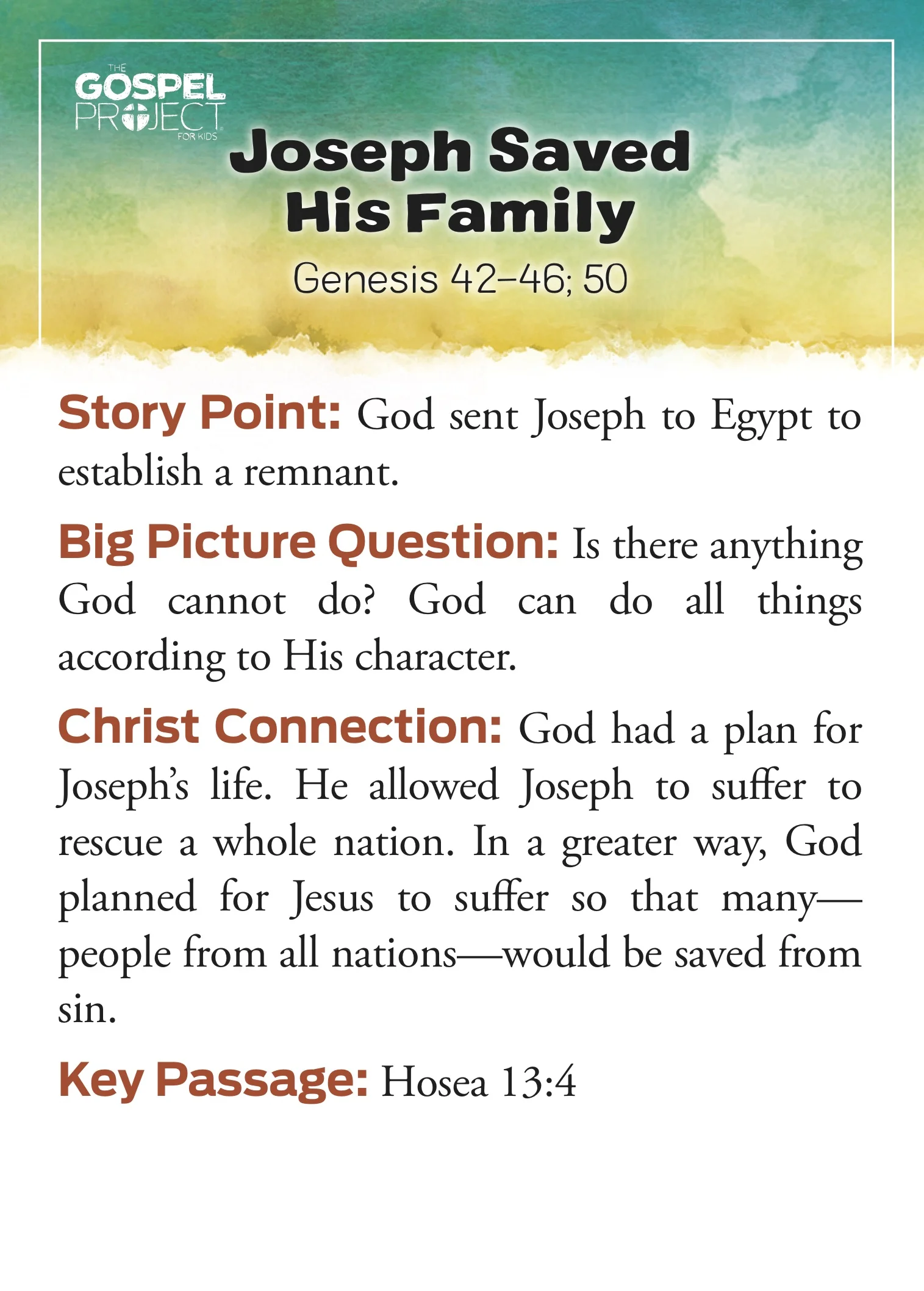
Family Devotional: Joseph Saved His Family
Dear Parents,
Last week, kids learned that God had a plan for Joseph’s suffering. The land of Egypt enjoyed seven years of plenty before a famine struck, just as Pharaoh had dreamed. During that time, Joseph gathered all the excess food and stored it in the cities. The famine was severe in every land, so Joseph opened the storehouses and sold grain to everyone who needed it.
Jacob and his family lived in Canaan, and Jacob sent his sons to Egypt for grain. Jacob still felt the sting of losing Joseph. He did not allow his youngest son, Benjamin, to go for fear of losing him too. But Joseph wasn’t dead. He was in Egypt and had been elevated to a position of authority. As his sons headed to Egypt, Jacob had no idea that the journey would lead to a family reunion.
Although Joseph recognized his brothers immediately, they did not recognize him. When Joseph finally revealed his identity to his brothers, they must have been in awe that the brother they sold into slavery was now a powerful leader in Egypt! Would Joseph use his authority to rescue his family from the famine? Or would he avenge his brothers’ evil against him?
What Joseph’s brothers intended for harm, God intended for good. Joseph invited his family to come to Egypt where they could thrive. God clearly used Joseph to provide for Jacob’s family and establish a remnant. As Jacob made his way to Egypt, God spoke to him in a vision and repeated the promise He first made to Abraham: “I will make you into a great nation” (Gen. 46:3).
Joseph and his father’s family stayed in Egypt. Before he died, Joseph reminded his brothers of God’s promise to their family. (See Gen. 50:24.) Despite Egyptian oppression, Jacob’s descendants multiplied. God kept His promise, and through the nation of Israel and the tribe of Joseph’s brother Judah, God worked out His plan to provide His Son, Jesus Christ to redeem people from sin.
Emphasize to your kids that God had a plan for Joseph’s life. He allowed Joseph to suffer to rescue a whole nation. In a greater way, God planned for Jesus to suffer so that many—people from all nations—would be saved from sin.